


As Canada crosses NATO’s 2% of GDP defence spending threshold and sets its sights on the bolder 5% Defence Investment Pledge by 2035, the real test is not dollars spent but capabilities delivered. Budget 2025 and the new Arctic investments promise a stronger Canadian Armed Forces (CAF), yet persistent gaps in serviceability raise serious questions about whether the Royal Canadian Navy, Army, and Air Force can fully deliver on Arctic sovereignty, NORAD commitments, and national defence in an era of heightened pressures—including recent U.S. comments on Canada as a potential “51st state.”
Background and Policy Shift
On March 26, 2026, Prime Minister Mark Carney announced aboard a Royal Canadian Navy warship in Halifax that Canada had met the 2% benchmark for the 2025–26 fiscal year. NATO confirmed roughly $63 billion in total defence expenditure—the largest single-year jump in generations.
Budget 2025 commits $81.8 billion over five years for pay raises, sustainment, infrastructure, and capability growth. The February 2026 Defence Industrial Strategy adds $6.6 billion under a “Build–Partner–Buy” model targeting 70% Canadian content and up to 125,000 jobs by 2035. In March 2026, a dedicated $35 billion decade-long Arctic defence package was unveiled for expanded airfields, operational support hubs (Iqaluit, Inuvik, Yellowknife), and dual-use northern infrastructure.
At the 2025 NATO Summit, allies including Canada adopted a new goal: 5% of GDP in total defence and security investments by 2035 (3.5% core military + 1.5% critical infrastructure). The River-class Destroyer program and other procurements are central to this trajectory.
The Readiness Baseline
Serviceability—the proportion of personnel, platforms, and systems ready to deploy and sustain operations—remains the critical metric. Internal DND assessments from late 2025/early 2026 indicate only about 58% of the CAF could effectively respond to a major contingency. Roughly half the fleet is unserviceable: ~54% of key naval platforms, 46% of army vehicles, and 55% of air force aircraft/support fleets. These figures pre-date full 2025–26 spending impacts, but chronic spare-parts shortages, aging equipment, and procurement delays continue to constrain availability.
Personnel Challenges and Progress
The CAF sits roughly 15,000 members below authorized strength. Recruitment applications rose 13% after major compensation improvements and new Express Entry pathways for pilots, technicians, and specialists. Median processing times remain around 271 days, and training establishments operate at about 80% capacity due to instructor shortages.
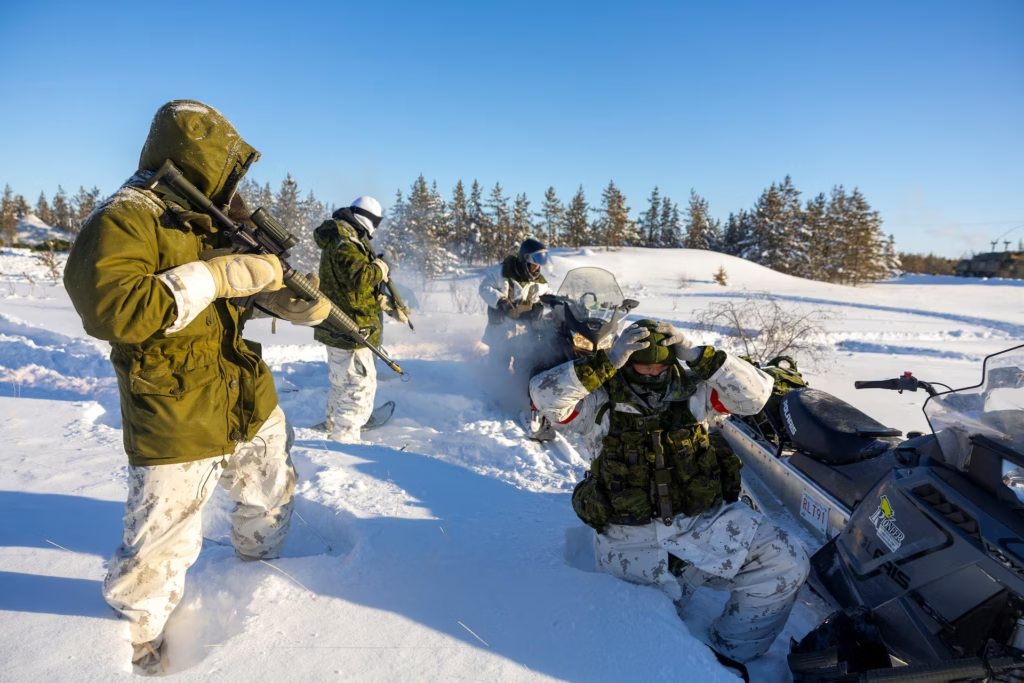
Arctic-specific demands—cold-weather acclimatization, remote sustainment, and long-range patrols—add layers of complexity. Reserve initiatives like Task Force Grizzly and concepts for a larger strategic reserve (civilian augmentation in crisis) offer pathways, but scaling deployable northern-ready forces will take years.
Equipment Serviceability and the Arctic Imperative
Harsh Arctic conditions accelerate wear on platforms, making serviceability even more difficult. Legacy fleets (CF-18 transitions, Halifax-class upgrades) face ongoing maintenance backlogs. The Defence Industrial Strategy and $35 billion Arctic package prioritize domestic spares production, sensors, ice-capable vessels, and infrastructure to improve this.
Key Arctic-focused elements:
- Expanded operations in 2026: Operation Nanook (including Nunalivut along the Northwest Passage), Qimaavivut (engineering/infrastructure), Limpid (surveillance), Boxtop (logistics), and Latitude (western Arctic maritime defence).
- NORAD modernization: Upgraded over-the-horizon radar, command systems, and dual-use basing.
- Serviceability targets: 75% naval vessels, 80% army vehicles, 85% air force aircraft by decade’s end.
The River-class Destroyer program directly supports this. With first steel cut on HMCS Fraser in 2025 and delivery in the early 2030s, these advanced surface combatants will provide the high-end presence needed for Arctic and blue-water sovereignty enforcement.

Training, Infrastructure, and Budget Execution
The $81.8 billion package allocates approximately:
- $20.4 billion for personnel (pay, retention, health care);
- $19 billion for sustainment and infrastructure (spares, repairs, Arctic facilities);
- $17.9 billion for capability growth (vehicles, munitions, sensors, domestic industry).
Canada now meets NATO’s 20% equipment investment guideline. Expanded northern training ranges, logistics hubs, and dual-use facilities aim to reduce southern resupply dependence and enable year-round presence. However, regulatory hurdles and remote-project challenges have historically slowed execution. The Industrial Strategy seeks to shorten these timelines through Canadian industry prioritization.

Chief of the Defence Staff General Jennie Carignan has stressed preparation for a changed security environment, with sustained northern operations as a priority.
Strategic Importance for Sovereignty
These investments matter most in the Arctic, where vast distances, the Northwest Passage, and resource potential demand persistent, independent Canadian presence. Melting ice creates new navigation and economic opportunities alongside increased international interest. Robust CAF serviceability strengthens Canada’s hand in managing its territory, waters, and resources amid bilateral pressures and continental defence discussions.

While NORAD cooperation with the United States remains essential, reducing reliance on allied assets for core northern tasks ensures sovereignty decisions stay firmly Canadian. The River-class Destroyers, Arctic infrastructure, and improved readiness across domains will form the backbone of that independent posture through 2050 and beyond.
Moving Forward
Achieving 2%—and progressing toward 5%—provides a strong financial foundation. The next 24–36 months will reveal whether funding translates into measurable gains: higher serviceability rates, faster recruiting-to-operational timelines (especially Arctic-qualified), and sustained training output in demanding environments.
Positive signals include accelerated spares procurement, ongoing 2026 Arctic operations, and steady River-class construction progress. Sustained multi-year commitment, procurement reform, northern project acceleration, and transparent readiness reporting will be decisive.
Canada has crossed the 2% threshold. The deeper measure of success lies in the day when a substantially higher share of CAF personnel, ships, aircraft, and vehicles can reliably operate—particularly across the vast and vital Arctic. That operational substance, not just spending percentages, will secure Canada’s sovereignty for decades to come.


